
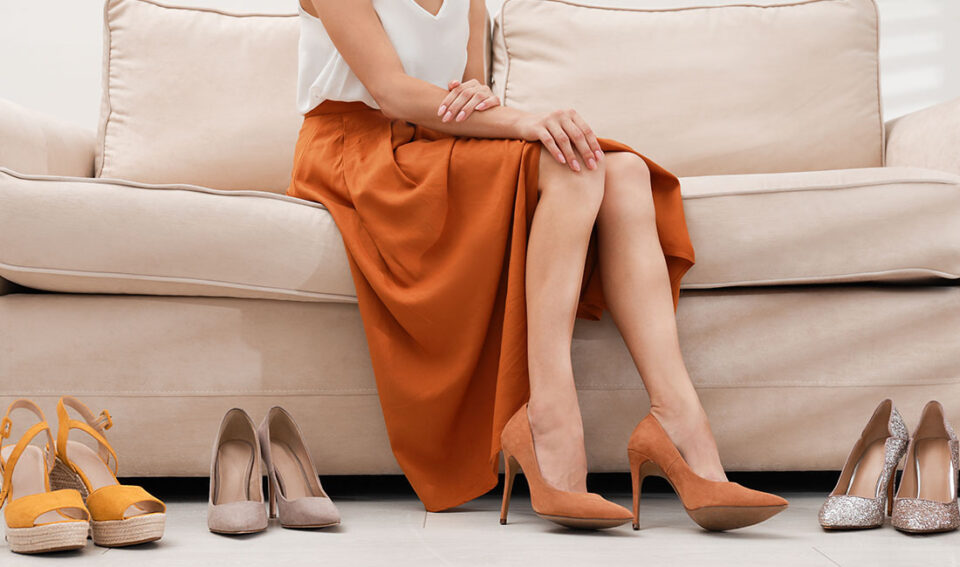
The best shoes for a knee-length dress are usually pointed-toe pumps, ballet flats, block heels, slim sandals, and knee-high boots. The right choice depends on the exact hem position, dress shape, season, occasion, and shoe color. Because a knee-length hem stops near the widest part of the leg, the shoe should help keep the leg line clean and balanced.
Based on footwear styling and fit principles, this guide explains how to pair shoes with knee-length dresses. It covers proportion, heel height, flats, boots, sandals, dress silhouettes, office outfits, wedding guest looks, seasonal choices, color matching, and common mistakes to avoid.
What Shoes Look Best With A Knee-Length Dress?
The strongest shoe pairings for a knee-length dress are pointed-toe pumps, ankle-strap heels, ballet flats, and knee-high boots. Each works because it complements the visual break the knee creates. The right pick depends on hem position, dress silhouette, and occasion.
Three factors decide the final shoe choice for a knee-length dress: the hem position, the dress silhouette, and the formality of the event. Each factor narrows the options.
The four shoe families that work across most knee-length dresses are listed below.
- Pointed-toe pumps — sleek and elongating, suited for office, cocktail, and formal events
- Ankle-strap heels — secure and dressy, suited for evenings and weddings
- Ballet flats — comfortable and classic, suited for casual and smart-casual outfits
- Knee-high boots — slim and structured, suited for fall and winter pairings
Why Does Proportion Matter More With A Knee-Length Dress?
A knee-length hem ends at the leg’s widest visible point. Adding another horizontal break from the shoe — at the ankle, mid-calf, or top of the foot — shortens the leg further. Shoes that create a vertical line either upward or downward preserve the silhouette. This is why how a shoe fits around the ankle and instep matters as much as the toe shape or heel height.
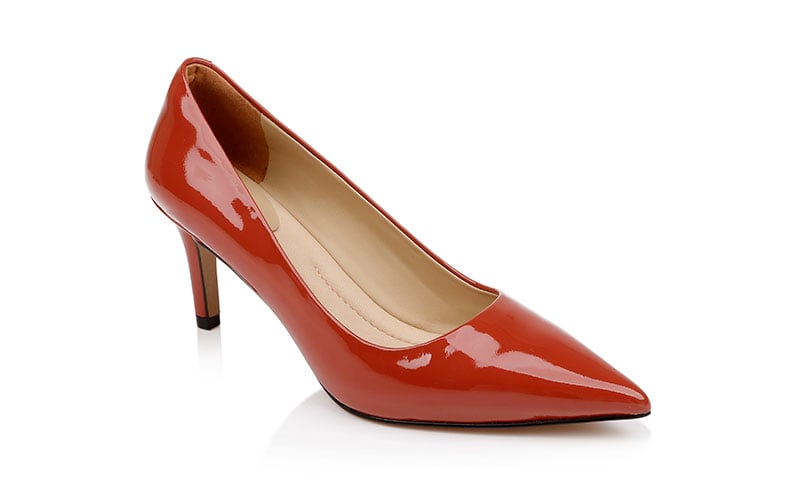
The visual break problem is unique to knee-length dresses. A maxi hem hides the entire leg. A mini hem exposes the full calf. A knee-length hem stops where the eye registers width, which makes proportion the deciding factor.
Three shoe features create a clean vertical line.
- Pointed toe — extends the leg’s visual line forward
- Skin-tone color — blends the shoe with the leg
- Low or no ankle strap — avoids cutting the foot from the leg
How Does The Exact Hem Position Change The Shoe Choice?
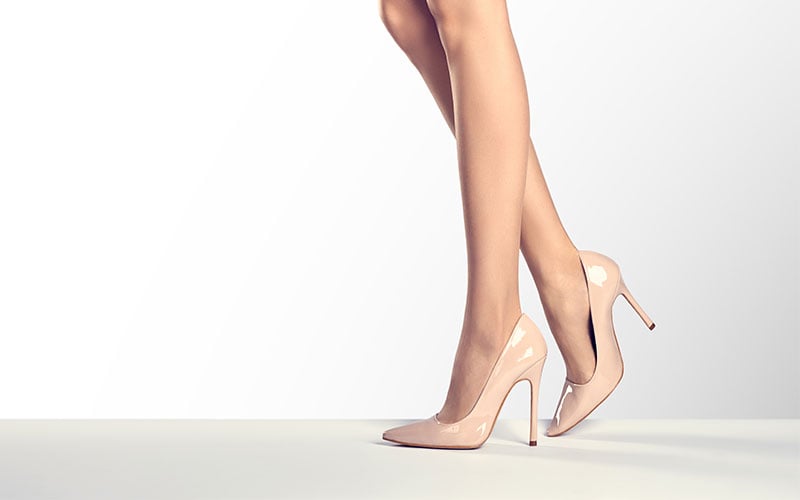
Three hem positions exist within “knee-length.” Above-knee hems (1 to 2 inches above the kneecap) elongate the leg and pair with most shoes. Hems sitting on the kneecap need pointed-toe shoes for length. Below-knee hems pair best with strappy or thin-profile shoes.
The wearer’s height shifts the ideal hem. A 5’2″ frame looks longer in an above-knee hem with a pointed flat. A 5’10” frame can carry a just-below-knee hem with a chunky-heeled ankle boot. The dress fixes the hem, but the shoe adapts to it.
The table below maps hem position to recommended shoe types.
| Hem Position | Visual Effect | Best Shoe Type |
| 1 to 2 inches above knee | Elongates leg most | Pointed flats, ankle boots, kitten heels |
| On the kneecap | Neutral, can shorten | Pointed pumps, slim sandals |
| Just below knee (1 inch) | Adds visual length below | Strappy heels, thin-strap sandals |
Which Heels Flatter A Knee-Length Dress?
Pointed-toe pumps, kitten heels, block heels, and strappy heeled sandals all flatter a knee-length dress. Pointed pumps elongate the leg most. Block heels balance fuller silhouettes. Kitten heels suit petite frames and the office. Strappy sandals add visual length through the open foot.
Heel height between 2 and 4 inches is the safest range for a knee-length dress. A 4.5-inch stiletto can overwhelm a fitted sheath. A 1-inch kitten heel can look too low under a structured silhouette.
The list below summarizes heel types and their best use cases.
- Pointed-toe pumps (2 to 4 inches) — office, cocktail events, fitted sheath dresses
- Block heels (2.5 to 4 inches) — weddings, garden parties, A-line dresses
- Kitten heels (1.5 to 2.5 inches) — petite frames, daytime office, brunch
- Strappy heeled sandals (3 to 4 inches) — evening events, formal cocktail
- Closed-toe pumps — corporate office, formal interviews
Which Flats Suit A Knee-Length Dress?
Pointed-toe flats, ballet flats, loafers, and flat mules work as flats with a knee-length dress. Pointed styles elongate the leg without adding height. Loafers pair professionally with sheath dresses. Round-toe ballet flats work best with above-knee hems for petite wearers.
Flat shoes work best when the hem sits 1 to 2 inches above the kneecap. A flat with a below-knee hem can shorten the leg for petite wearers. Pointed-toe flats compensate by extending the leg’s visual line forward.
The list below summarizes flat options for knee-length dresses.
- Pointed-toe flats — work, smart-casual, sheath and bodycon dresses
- Ballet flats — brunch, errands, fit-and-flare dresses with above-knee hem
- Loafers — corporate office, knit shirtdresses, structured wraps
- Flat mules — day-to-night transitions, linen and cotton dresses
- Low pumps (1 to 2 inches) — office, structured dresses
Which Boots Pair Well With A Knee-Length Dress?
Knee-high boots, ankle boots, and over-the-knee boots all pair with knee-length dresses. The non-negotiable rule is that the boot shaft must never end at the same height as the dress hem. The shaft should sit at least 1 inch above or below the hem to preserve a clean leg line.
Boot-shaft alignment is the most common styling mistake with knee-length dresses. A knee-high boot ending at the same height as the hem creates a stacked horizontal break. Slim shafts work better than wide shafts. The choice between leather and suede also affects formality — leather reads more polished, suede reads more relaxed.
The table below covers each boot type and its optimal alignment.
| Boot Type | Shaft Position vs. Hem | Best Knee-Length Style |
| Ankle boots | At least 4 inches below hem | Sheath, A-line, fit-and-flare |
| Knee-high leather boots | 1 inch above or below hem | Sheath, sweater, wrap dress |
| Knee-high suede boots | Same rule, softer line | Knit, casual sheath, A-line |
| Over-the-knee boots | Above knee, hem covers top | Slim sweater dress, bodycon |
Tights of 60 to 80 denier extend the visual line in winter and should match the dress or boot in tone.
Which Sandals Work With A Knee-Length Dress?
Strappy heeled sandals, block-heel sandals, ankle-strap sandals, and wedge sandals all work with a knee-length dress in warm weather. Wide-band sandals visually cut the foot and shorten the leg. Nude or skin-tone sandals create the longest visible leg line.
Sandal selection follows the same proportion rule as other shoe families. Thin straps preserve the leg line. Chunky bands across the foot add a horizontal break and shorten the silhouette.
The list below covers sandal types and their best knee-length pairings.
- Strappy heeled sandals — silk and satin dresses, evening cocktail events
- Block-heel sandals — wedding guest, A-line and wrap dresses
- Ankle-strap sandals — fitted sheath and bodycon dresses for date night
- Wedge sandals — outdoor events, garden parties, fit-and-flare dresses
- D’Orsay sandals — chiffon and satin cocktail dresses
How Does The Dress Silhouette Change The Shoe Choice?
Fitted silhouettes pair with delicate shoes. Voluminous silhouettes pair with substantial shoes. Sheath and bodycon dresses suit pumps and pointed flats. A-line and fit-and-flare dresses balance with block heels or ankle boots. Wrap dresses work with most shoe families.
The table below maps silhouette to recommended shoe family:
| Dress Silhouette | Best Shoe Family | Avoid |
| Sheath / bodycon | Pointed pumps, kitten heels, pointed flats | Wide-strap sandals |
| A-line / fit-and-flare | Block heels, ankle boots, wedges | Stilettos with thin straps |
| Wrap dress | Pumps, ankle boots, ballet flats | Combat boots |
| Shirtdress (knee-length) | Loafers, white sneakers, flat mules | Stilettos |
| Sweater dress | Knee-high boots, ankle boots | Strappy sandals |
What Shoes Match A Knee-Length Dress For Different Occasions?
Occasion sets the formality of the shoe more than fabric or season. Pumps and ballet flats suit the office. Block heels and ankle-strap heels work for weddings. Pointed pumps and ankle-strap heels suit cocktail events. Loafers, flat mules, and white sneakers fit casual outings.
Shoe-to-occasion matches that work without exception are listed below:
- Office or corporate — pointed pumps, low pumps, loafers, ballet flats
- Wedding guest (formal) — block heels, ankle-strap heels, wedge sandals
- Cocktail or date night — pointed pumps, ankle-strap heels, mules
- Casual day — flat mules, loafers, white sneakers, ballet flats
- Job interview — closed-toe pumps, polished low pumps, structured loafers
- Outdoor event — wedges, block-heel sandals, pointed flats
What Shoes Work In Each Season With A Knee-Length Dress?
Season decides the shoe material and coverage. Summer favors strappy sandals and wedges. Fall pairs ankle boots and loafers in suede. Winter requires knee-high boots layered with opaque tights. Spring transitions through pointed flats and kitten heels.
Seasonal pairings are summarized below:
- Summer (June to August) — strappy heeled sandals, wedge sandals, pointed flats
- Fall (September to November) — suede ankle boots, knee-high boots, loafers
- Winter (December to February) — knee-high leather boots, leather ankle boots
- Spring (March to May) — pointed-toe flats, kitten heels, low pumps
How Do You Coordinate Shoe Color With A Knee-Length Dress?
Three rules apply. Choose nude or skin-tone shoes to extend the leg line most. Match a tonal shade in the same family as the dress for cohesion. Or use a contrasting color if the rest of the outfit stays neutral.
Color rules summarized by knee-length dress base color are listed below:
- Black knee-length dress — nude, metallic gold or silver, matching black
- White or cream dress — tan, nude, metallic, or one accent color
- Floral or printed dress — neutral nude or tan, OR one print color pulled into the shoe
- Navy or jewel-tone dress — nude, metallic, or tonal same-family color
- Pastel dress — white, nude, metallic silver, matching pastel
What Shoes Should You Avoid With A Knee-Length Dress?
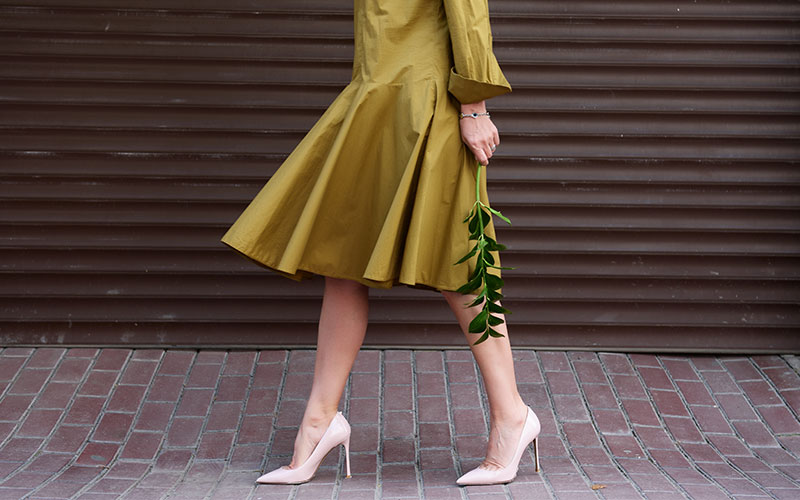
Avoid shoes that create a horizontal line at mid-calf or just below the knee. Chunky ankle straps, wide T-straps, and boots ending at the same height as the dress hem all break the leg line. Round-toe shoes can shorten petite frames in this hem range.
The proportion of mistakes specific to knee-length dresses are different from those for maxi or midi dresses. The knee-length hem highlights the calf and ankle, so any shoe that adds visible weight to that area shortens the look.
The list below covers the main shoes to avoid.
- Chunky ankle-strap shoes — they cut the foot from the leg
- Boots that end at the dress hem — they create a stacked horizontal break
- Wide-band slides — they add weight at the foot and shorten the leg
- Heavy combat boots with fitted dresses — proportion clash
- Round-toe flats with floor-skimming hems — they shorten petite frames
FAQs
Can Sneakers Be Worn With A Knee-Length Dress?
Yes, with the right dress. White leather sneakers and low-profile canvas sneakers work with cotton, jersey, and shirtdress styles. Avoid sneakers with chunky soles or athletic builds, which clash with structured silhouettes like sheath or bodycon.
Can Flip-Flops Work With A Casual Knee-Length Dress?
No. Flip-flops break the visual line and read too casual. Elevated flat slides or simple sandals work in casual outfits instead.
Should Hosiery Be Worn With A Knee-Length Dress?
Yes, in fall and winter. Opaque tights in 60 to 80 denier add warmth and extend the leg’s visual line. Sheer hosiery in summer is unnecessary and adds visible texture.
Do Calf Width And Shape Change The Boot Choice?
Yes. Knee-high boots with wider shaft widths accommodate fuller calves without breaking proportion. Slim shafts work best for slim calves. Choosing the correct shaft width for calf size is the key fit decision for this boot type.
What Is The Difference Between Knee-Length And Midi Dress Shoes?
Knee-length shoes focus on proportion at the knee, the leg’s widest visual point. Midi dress shoes focus on the calf, where the hem ends mid-calf. Knee-length pairings prioritize leg-extension techniques. Midi pairings prioritize ankle-clearance.
How Does Body Type Change The Shoe Choice?
Petite frames need pointed-toe shoes and nude tones to elongate. Tall frames can carry chunky shoes confidently. Curvy frames are flattered by block heels and pointed pumps. Wide calves benefit from stretch-shaft boots.